James Thomas (Tom) Clarke (11 March 1857-3 May 1916).
It was an Irish revolutionary leader and arguably the person most responsible for the 1916 Easter uprising.
Born in the Isle of Wight, and his father, James Clarke, was a sergeant in the British Army. His family soon moved to Dungannon, county of Tyrone, Ireland.
At the age of 18 James joined the Irish Republican Brotherhood (IRB) and in 1883 was sent to London to fly as London Bridge parte Explosives Bell encouraged by Jeremiah O'Donovan Rossa, one of the leaders exile, the IRB in the United States.
Clarke was arrested soon, under the alias of "Henry Wilson", along with several scammers. He was tried and sentenced to hard labor for life on May 28, 1883.
Subsequently, step 15 in Pentonville and other British prisons. In 1896, he was one of five Fenian prisoners in British jails and a series of public meetings in Ireland called for his release. In one such meeting, John Redmond, leader of the National League Parnellite Ireland, said:
"Wilson is a man for whom noh enough words of praise, I learned in my many visits to Portland During the five Jahr Honoring love and respect Henry Wilson.'ve Seen day after day as a brave spirit kept him alive. .. I've seen year after year the fading of his physical strength. " Henry Wilson, as historian Dermot Meleady said, was the alias of Tom Clarke.
After his release in 1898 he moved to Brooklyn in the United States, where he married Kathleen Daly, 21 years his junior, whose uncle, John Daly, had met in prison.
In 1906 the couple moved to a farm of 30 acres in Manorville, New York and bought another 30 acres in 1907 shortly before returning to Ireland that year.
In Ireland snuff opened a shop in Dublin and plunged into the IRB, which was undergoing a major rejuvenation under the guidance of the younger men, as Bulmer Hobson and Denis McCullough.
miércoles, 12 de junio de 2013

miércoles, 5 de junio de 2013
Galway
Galway, is a city in Ireland. It is in the West Region and the province of Connacht. Galway City Council is the local authority for the city. Galway lies on the River Corrib between Lough Corrib and Galway Bay and is surrounded by County Galway. It is the fourth most populous city in the state and the sixth most populous on the island of Ireland.
Dún Bhun na Gaillimhe ("Fort at the Mouth (bottom) of the Gaillimh") was constructed in 1124, by the King of Connacht, Tairrdelbach Ua Conchobair (1088–1156). Eventually, a small settlement grew up around this fort. During the Norman invasion of Connacht in the 1230s, Galway fort was captured by Richard Mor de Burgh, who had led the invasion. As the de Burghs eventually became Gaelicised, the merchants of the town, the Tribes of Galway, pushed for greater control over the walled city.
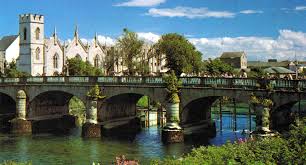
Dún Bhun na Gaillimhe ("Fort at the Mouth (bottom) of the Gaillimh") was constructed in 1124, by the King of Connacht, Tairrdelbach Ua Conchobair (1088–1156). Eventually, a small settlement grew up around this fort. During the Norman invasion of Connacht in the 1230s, Galway fort was captured by Richard Mor de Burgh, who had led the invasion. As the de Burghs eventually became Gaelicised, the merchants of the town, the Tribes of Galway, pushed for greater control over the walled city.
miércoles, 29 de mayo de 2013
Irish stew
Irish stew, is a traditional stew made from lamb, or mutton (mutton is used as it comes from less tender sheep over a year old, is fattier, and has a stronger flavour, and is generally the most traditional variation used) as well as potatoes, onions, and parsley. It may sometimes also include carrots. Irish stew is also made with kid goat.
Stewing is an ancient method of cooking meats that is common throughout the world. However, the Celts did not possess their first bronze cauldrons, copied from Greek models, until the seventh century BC. After the Celtic invasion of Ireland, the cauldron (along with the already established spit) became the dominant cooking tool in ancient Ireland, ovens being practically unknown to the ancient Gaels. The root vegetables and meat (originally goat) for the stew were then all in place, save for the potato. The introduction of the potato, originally a South American crop, did not occur until after the sixteenth century.

Stewing is an ancient method of cooking meats that is common throughout the world. However, the Celts did not possess their first bronze cauldrons, copied from Greek models, until the seventh century BC. After the Celtic invasion of Ireland, the cauldron (along with the already established spit) became the dominant cooking tool in ancient Ireland, ovens being practically unknown to the ancient Gaels. The root vegetables and meat (originally goat) for the stew were then all in place, save for the potato. The introduction of the potato, originally a South American crop, did not occur until after the sixteenth century.
Kinsale
Kinsale, is a fishing village in County Cork, Ireland. Located some 25 km south of Cork City on the coast near the Old Head of Kinsale, it sits at the mouth of the River Bandon and has a population of 2,257 which increases substantially during the summer months when the tourist season is at its peak and when the boating fraternity arrive in large numbers.
The town is known for its restaurants, and holds an annual "Gourmet Festival". Chef Keith Floyd was previously a resident of Kinsale. Prominent buildings in the town include St. Multose's church (Church of Ireland), St. John the Baptist (Catholic), the Market House and the so-called French Prison (or Desmond Castle).

The town is known for its restaurants, and holds an annual "Gourmet Festival". Chef Keith Floyd was previously a resident of Kinsale. Prominent buildings in the town include St. Multose's church (Church of Ireland), St. John the Baptist (Catholic), the Market House and the so-called French Prison (or Desmond Castle).
martes, 21 de mayo de 2013
Killarney national park

Charles fort
Charles Fort
is built on the site of an earlier stronghold known as Ringcurran Castle
lunes, 13 de mayo de 2013
Josephine Bernadette
Josephine Bernadette

Josephine Bernadette Devlin McAliskey: Irish Politics born in Cookstown, County Tyrone in 1947.
Highlighted in the revolts of Derry (1969), the Battle of the Bogside, while a student of psychology and following which it was stopped.
Favors a progressive nationalism, in 1969 she was elected to the House of Commons representing the Ulster.
Arrested for participating in those riots, lost his record of deputy in the 1974 elections.
He founded the Irish Republican Socialist Party (Irish Republican Socialist Party).
Bernadette Devlin appeared in the Spanish state newspapers of the time as a Catholic heroine was far enough to be considered terrorist.
Bernadette Devlin had the merit of being chosen to sit in the British Parliament, with only 21 years, becoming a symbol of belligerency of the Irish Catholics in the North. This was enough to attract attention worldwide in 1969.
Suscribirse a:
Entradas (Atom)