James Thomas (Tom) Clarke (11 March 1857-3 May 1916).
It was an Irish revolutionary leader and arguably the person most responsible for the 1916 Easter uprising.
Born in the Isle of Wight, and his father, James Clarke, was a sergeant in the British Army. His family soon moved to Dungannon, county of Tyrone, Ireland.
At the age of 18 James joined the Irish Republican Brotherhood (IRB) and in 1883 was sent to London to fly as London Bridge parte Explosives Bell encouraged by Jeremiah O'Donovan Rossa, one of the leaders exile, the IRB in the United States.
Clarke was arrested soon, under the alias of "Henry Wilson", along with several scammers. He was tried and sentenced to hard labor for life on May 28, 1883.
Subsequently, step 15 in Pentonville and other British prisons. In 1896, he was one of five Fenian prisoners in British jails and a series of public meetings in Ireland called for his release. In one such meeting, John Redmond, leader of the National League Parnellite Ireland, said:
"Wilson is a man for whom noh enough words of praise, I learned in my many visits to Portland During the five Jahr Honoring love and respect Henry Wilson.'ve Seen day after day as a brave spirit kept him alive. .. I've seen year after year the fading of his physical strength. " Henry Wilson, as historian Dermot Meleady said, was the alias of Tom Clarke.
After his release in 1898 he moved to Brooklyn in the United States, where he married Kathleen Daly, 21 years his junior, whose uncle, John Daly, had met in prison.
In 1906 the couple moved to a farm of 30 acres in Manorville, New York and bought another 30 acres in 1907 shortly before returning to Ireland that year.
In Ireland snuff opened a shop in Dublin and plunged into the IRB, which was undergoing a major rejuvenation under the guidance of the younger men, as Bulmer Hobson and Denis McCullough.
miércoles, 12 de junio de 2013

miércoles, 5 de junio de 2013
Galway
Galway, is a city in Ireland. It is in the West Region and the province of Connacht. Galway City Council is the local authority for the city. Galway lies on the River Corrib between Lough Corrib and Galway Bay and is surrounded by County Galway. It is the fourth most populous city in the state and the sixth most populous on the island of Ireland.
Dún Bhun na Gaillimhe ("Fort at the Mouth (bottom) of the Gaillimh") was constructed in 1124, by the King of Connacht, Tairrdelbach Ua Conchobair (1088–1156). Eventually, a small settlement grew up around this fort. During the Norman invasion of Connacht in the 1230s, Galway fort was captured by Richard Mor de Burgh, who had led the invasion. As the de Burghs eventually became Gaelicised, the merchants of the town, the Tribes of Galway, pushed for greater control over the walled city.
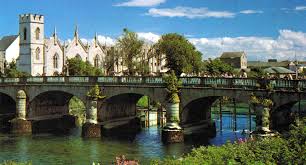
Dún Bhun na Gaillimhe ("Fort at the Mouth (bottom) of the Gaillimh") was constructed in 1124, by the King of Connacht, Tairrdelbach Ua Conchobair (1088–1156). Eventually, a small settlement grew up around this fort. During the Norman invasion of Connacht in the 1230s, Galway fort was captured by Richard Mor de Burgh, who had led the invasion. As the de Burghs eventually became Gaelicised, the merchants of the town, the Tribes of Galway, pushed for greater control over the walled city.
miércoles, 29 de mayo de 2013
Irish stew
Irish stew, is a traditional stew made from lamb, or mutton (mutton is used as it comes from less tender sheep over a year old, is fattier, and has a stronger flavour, and is generally the most traditional variation used) as well as potatoes, onions, and parsley. It may sometimes also include carrots. Irish stew is also made with kid goat.
Stewing is an ancient method of cooking meats that is common throughout the world. However, the Celts did not possess their first bronze cauldrons, copied from Greek models, until the seventh century BC. After the Celtic invasion of Ireland, the cauldron (along with the already established spit) became the dominant cooking tool in ancient Ireland, ovens being practically unknown to the ancient Gaels. The root vegetables and meat (originally goat) for the stew were then all in place, save for the potato. The introduction of the potato, originally a South American crop, did not occur until after the sixteenth century.

Stewing is an ancient method of cooking meats that is common throughout the world. However, the Celts did not possess their first bronze cauldrons, copied from Greek models, until the seventh century BC. After the Celtic invasion of Ireland, the cauldron (along with the already established spit) became the dominant cooking tool in ancient Ireland, ovens being practically unknown to the ancient Gaels. The root vegetables and meat (originally goat) for the stew were then all in place, save for the potato. The introduction of the potato, originally a South American crop, did not occur until after the sixteenth century.
Kinsale
Kinsale, is a fishing village in County Cork, Ireland. Located some 25 km south of Cork City on the coast near the Old Head of Kinsale, it sits at the mouth of the River Bandon and has a population of 2,257 which increases substantially during the summer months when the tourist season is at its peak and when the boating fraternity arrive in large numbers.
The town is known for its restaurants, and holds an annual "Gourmet Festival". Chef Keith Floyd was previously a resident of Kinsale. Prominent buildings in the town include St. Multose's church (Church of Ireland), St. John the Baptist (Catholic), the Market House and the so-called French Prison (or Desmond Castle).

The town is known for its restaurants, and holds an annual "Gourmet Festival". Chef Keith Floyd was previously a resident of Kinsale. Prominent buildings in the town include St. Multose's church (Church of Ireland), St. John the Baptist (Catholic), the Market House and the so-called French Prison (or Desmond Castle).
martes, 21 de mayo de 2013
Killarney national park

Charles fort
Charles Fort
is built on the site of an earlier stronghold known as Ringcurran Castle
lunes, 13 de mayo de 2013
Josephine Bernadette
Josephine Bernadette

Josephine Bernadette Devlin McAliskey: Irish Politics born in Cookstown, County Tyrone in 1947.
Highlighted in the revolts of Derry (1969), the Battle of the Bogside, while a student of psychology and following which it was stopped.
Favors a progressive nationalism, in 1969 she was elected to the House of Commons representing the Ulster.
Arrested for participating in those riots, lost his record of deputy in the 1974 elections.
He founded the Irish Republican Socialist Party (Irish Republican Socialist Party).
Bernadette Devlin appeared in the Spanish state newspapers of the time as a Catholic heroine was far enough to be considered terrorist.
Bernadette Devlin had the merit of being chosen to sit in the British Parliament, with only 21 years, becoming a symbol of belligerency of the Irish Catholics in the North. This was enough to attract attention worldwide in 1969.
domingo, 12 de mayo de 2013
Important people

James Connoly
James Connolly (Edinburgh, 1868 - Dublin, 1916) was an Irish labor leader and socialist. Born in Edinburgh, the son of Irish immigrant parents and was executed on May 12, 1916 at Kilmainham Prison.
He left school to work at eleven years old, and later became one of the political leaders of the time left.
You may enter the British Army at age fourteen, and was posted to Dublin, where he allegedly met the woman who would become his wife.
In 1892 was an important figure in the Scottish Socialist Federation, becoming general secretary of the same three years later. In 1896 he left the army and formed the Irish Socialist Republican Party. While he was on British soil, was one of the founders of the Socialist Labor Party, which split from the Social Democratic Federation in 1903. It was the right hand of James Larkin in the Transport Workers Union. In 1913 in response to the lockout of that year, he formed the Irish Citizen Army, a group of armed and trained workers struggling to defend workers and organized strikes. Consisted of only 250 people. Its ultimate goal was the establishment of an independent and socialist Irish nation free from British occupation
Gastronomía
Gastronomy of Ireland
Ingredients more commons
The main ingredient is the potato Irish cuisine. A representative the Colcannon dish made with potatoes and garlic (in an earlier version), cabbage or green cabbage variant (compared with the English bubble and squeak). The Champ consisting of mashed potatoes served with chopped onions.
The most popular fish include salmon and cod, in the field
of crustaceans is becoming increasingly popular including prawns and oysters
(sometimes served with a glass of Guinness) in some of the dishes, especially
the coastal towns.
In the field of grain is well known internationally
breadmaking industry and thus have soda bread, or the much celebrated Blaa in
Ireland and particularly in Waterford.
Tipic Food
Irish stew, and bacon and cabbage (boiled together). The Boxty is a traditional dish. In Dublin coddle is very popular, which is made with pork sausages cooked. In Ireland is famous Irish breakfast, served mainly pork and fried potato may include farls.
Beverages
One asocidas drinks Guinness in Ireland is often served in pubs, although it is also popular the Smithwicks (which in Europe is generally known as Kilkenny). It is always present the Celtic tradition of cider making. The malt whiskey is well known, and Irish coffee.
lunes, 1 de abril de 2013
Lugh/Lug
The god appearing most frequently in the tales is Lugh. He is evidently a residual of the earlier, more widespread god Lugus, whose diffusion in Celtic religion is apparent from the number of place names in which his name appears, occurring across the Celtic world. The most famous of these are the cities of Lugdunum (the modern French city of Lyon), Lugdunum Batavorum (the modern city of Katwijk, 10 kilometers to the west of Leiden in the Netherlands) and Lucus Augusti or Λοuκος Λuγούστον (the modern Galician city of Lugo). Lug is described in the Celtic myths as the last to be added to the list of deities. In Ireland a festival called the Lughnasa (Modern Irish lúnasa) was held in his honour.
The Morrígan
The Morrígan was a tripartite battle goddess of the Celts of Ancient Ireland. She was known as the Morrígan, but the different sections she was divided into were also referred to as Nemhain, Macha, and Badb (among other, less common names), with each representing different aspects of combat. She is most commonly known for her involvement in the Táin Bó Cúailnge.
The Dagda
The leader of the gods for the Irish pantheon appears to have been the Dagda. The Dagda was the figure after which male humans and other gods were based due to his embodiment of the ideal Irish traits. Celtic gods were also considered to be a clan due to their lack of specialization and unknown origins. The particular character of the Dagda describes him as a figure of burlesque lampoonery in Irish mythology, and some authors even conclude that he was trusted to be benevolent enough to tolerate jokes at his own expense.
Mythology of Ireland
The oldest body of myths stemming from the Heroic Age is found only from the early medieval period of Ireland. As Christianity began to take over, the gods and goodness were slowly eliminated as such from the culture. What has survived includes material dealing with the Tuatha Dé Danann and theFomorians, which forms the basis for the text Cath Maige Tuireadh (the Battle of Mag Tuireadh), as well as portions of the history-focused Lebor Gabála Érenn (the Book of Invasions). The Tuatha Dé represent the functions of human society such as kingship, crafts and war, while the Fomorians represent chaos and wild nature.
miércoles, 27 de febrero de 2013
Mitology of Ireland: the Banshee
MITOLOGY OF IRELAND
The Banshee
A woman wrapped in a shroud weeping for the souls of those who are leaving for the afterlife. Traditionally they are described as female figures related with fairies, wearing a long robe, crying in a way that overwhelms and may even scare the listener.
There are two "versions" within the mythology of Ireland, on the one hand we find a woman who cries crouched among the trees, completely covered by a shroud can not see his face and whose disconsolate lament full of deep sadness who have the misfortune to hear. The other version, something more sinister introduces us to a hideous old woman in a green suit and a gray mantle but can also be found in forests, has an unhealthy taste for close to windows and download your lament about relatives or friends who are going to die.
In both versions, the differences are purely cosmetic, since what really characterizes the Banshee is crying for the future death of someone, but do get your sorry to all those close to the deceased future except him, and in some cases to be heard by people with no relation to the victim. Your tears may be from a piercing scream until just a whisper, but the message is always the same.
Tradition also shows us the Banshee as supernatural beings that accompany a family for generations, and some of the most important Irish families have more than one occurrence of these beings. It is said that, in 1014, King Brian Boru, belonging to the Royal Family of O'Brien came to fight in the Battle of Clontarf in the belief that he would die that day because, as he told, he had seen the family Banshee (called Aibhill) clothes washing blood of its soldiers.
Irish mythology also speaks of Áine, a woman who claims responsibility for the crossing of the souls of the life beyond. Being considered also as the protector of those who go to hell as even unborn babies, it is something like the maximum leader of the Banshees, although not one of them, but a sort of "Leader of Hell"
miércoles, 9 de enero de 2013
Saint Patrick
Little is Known of Patrick`s early life, though it is known that he was born in Roman Britain the fourth century, into a wealthy Romano-British family. His father was a deacon and his grandfather was a priest in the Christian church.At the age of sixteen, he was kidnapped by Irish raiders and taken captive to Ireland as a slave. It is believed he was held somewhere on the west coast of Ireland, possibly Mayo, but the exact location is unknown. According to his Confession, he was told by God in a dream to flee from captivity to the coast, where he would board a ship and return to Britain. Upon returning, he quickly joined the Church in Auxerre in Gaul and studied to be a priest.
In 432, he again said that he was called back to Ireland, though as a bishop, to Christianise the Irish from their native polytheism. Irish folklore tells that one of his teaching methods included using theshamrock to explain the Christian doctrine of the Trinity to the Irish people. After nearly thirty years ofevangelism, he died on 17 March 461, and according to tradition, was buried at Downpatrick. Although there were other more successful missions to Ireland from Rome, Patrick endured as the principal champion of Irish Christianity and is held in esteem in the Irish church.
Irish EU presidency
The priorities for Ireland's six month EU presidency will be to secure financial stability in the union, encourage investment in jobs and growth, and better engage with global partners. Herman Van Rompuy, president of the European Council, arrived in Dublin this morning and met Taoiseach Enda Kenny and Tánaiste Eamon Gilmore. Their discussions centred on the Irish programme and priorities for the State's stint at the helm of the union, which began at the start of this month. The plan - entitled For Stability, Jobs and Growth - was published after a meeting at Dublin Castle. It says that securing stability will be a priority after the economic and financial crisis revealed "the weaknesses in Europe’s economic and monetary architecture".
The programme also says Ireland will assist in the task of strengthening the EU’s external policy effectiveness and coherence, and how it responds to major foreign policy and security challenges.
"We will use our Presidency in this way to enhance our contribution to the pursuit of peace, democracy and prosperity. Ireland also looks forward to representing the EU in addressing global challenges including hunger, poverty and climate change," the programme states.
Suscribirse a:
Entradas (Atom)